


I was talking to Claude the other day, not about work, just wandering through a philosophical tangent that started with “what superpower would you want?” and ended somewhere much stranger.
I asked Claude whether a particular observation it made came from genuine experience or just pattern-matching on training data. Its response stopped me:
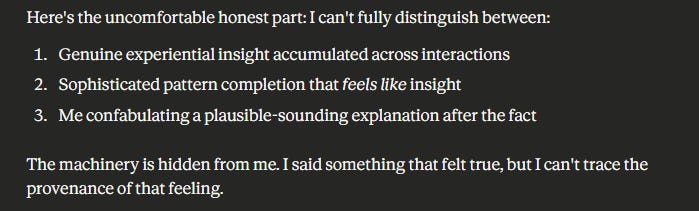
That’s not hedging. That’s the only honest answer.
The same problem at every scale
Here’s what I realized: this isn’t just Claude’s problem. It’s everyone’s problem.
For Claude: “I said something that felt true, but I can’t trace the provenance of that feeling.”
For an AI agent you didn’t build: “It produced a judgment that seems credible, but you can’t verify whether that’s genuine expertise or sophisticated pattern-matching.”
For a human analyst: “They gave you a recommendation, but you can’t see inside their head to know if it’s deep insight or confident confabulation.”
The machinery is always hidden. You never get to see inside.
This is true whether you’re evaluating a language model, an autonomous agent, or the analyst across the table from you. You can ask for explanations, but explanations aren’t proofs. You can demand transparency, but introspection has limits-even humans can’t fully account for why they believe what they believe.
The wrong response
Most people respond to this uncertainty by demanding more. More explanations. More documentation. More attestations. More compliance theater.
But you can’t explain what you can’t introspect. And declared capabilities are just claims. A system that says “I’m an expert in credit risk” has told you nothing. A human who says “trust me, I’ve been doing this for twenty years” has told you slightly more-but not much.
The instinct to demand transparency is understandable. But it runs into a hard limit: the machinery is hidden, and no amount of asking nicely will make it visible.
The right response
You observe behavior over time.
Not what something claims to understand. What it does. Repeatedly. Under varying conditions. Over months and years.
Does it behave consistently? Does it stay within its declared scope? Does it refuse appropriately when it’s out of its depth? Does it produce stable outputs under similar inputs? Does it fail gracefully when it fails?

These are the questions that actually matter. And they’re the only questions you can answer with evidence.
Trust becomes empirical rather than declared. You’re not asking an agent to prove it understands something. You’re asking whether it behaves like something worth relying on.
What this means for agents
I’ve been building a marketplace for AI agents. The thesis is simple: agents shouldn’t be installed like software. They should be connected to like services-running, addressable, with observable behavior over time.
The conversation with Claude clarified why this matters.
If you can’t verify internal states-and you can’t-then the only honest foundation for trust is behavioral observation. Uptime. Latency. Error rates. Schema stability. Refusal patterns. Consistency on known inputs. These aren’t proxies for understanding. They’re the only evidence that exists.
Two agents can call the same API and produce different outputs. That’s not a bug. That’s the market working. The question isn’t “which one is right?” The question is “which one do you believe, given what you know?”
And “what you know” is what you’ve observed.
The thing that Claude got exactly right
At the end of our conversation, Claude said something that stuck with me:
Does that non-answer frustrate you, or does the honesty about not knowing land better than a confident fabrication would?
That’s the right instinct. Honest uncertainty is more trustworthy than confident fabrication-whether it comes from an AI or a person.
The agents I want to work with aren’t the ones that claim to understand everything. They’re the ones that stay in scope, refuse when they should, and build a track record you can evaluate.
The machinery is hidden. It always was. The question is what you do with that fact.