


I dropped a headline into Claude yesterday.
China has given the green light to three of its largest tech companies to buy Nvidia’s H200 artificial intelligence chips.
No setup. No configuration. I just asked: is this signal or noise for NVDA?
The agent came back in seconds.
Strong signal. High salience (0.85) with 90% confidence. Classification: signal, not noise. Impact: 400,000+ H200 chips at $30K each, potential $12B in orders. Strategic importance: China market access has been a major overhang. Regulatory shift: Beijing changing stance on US chip purchases.
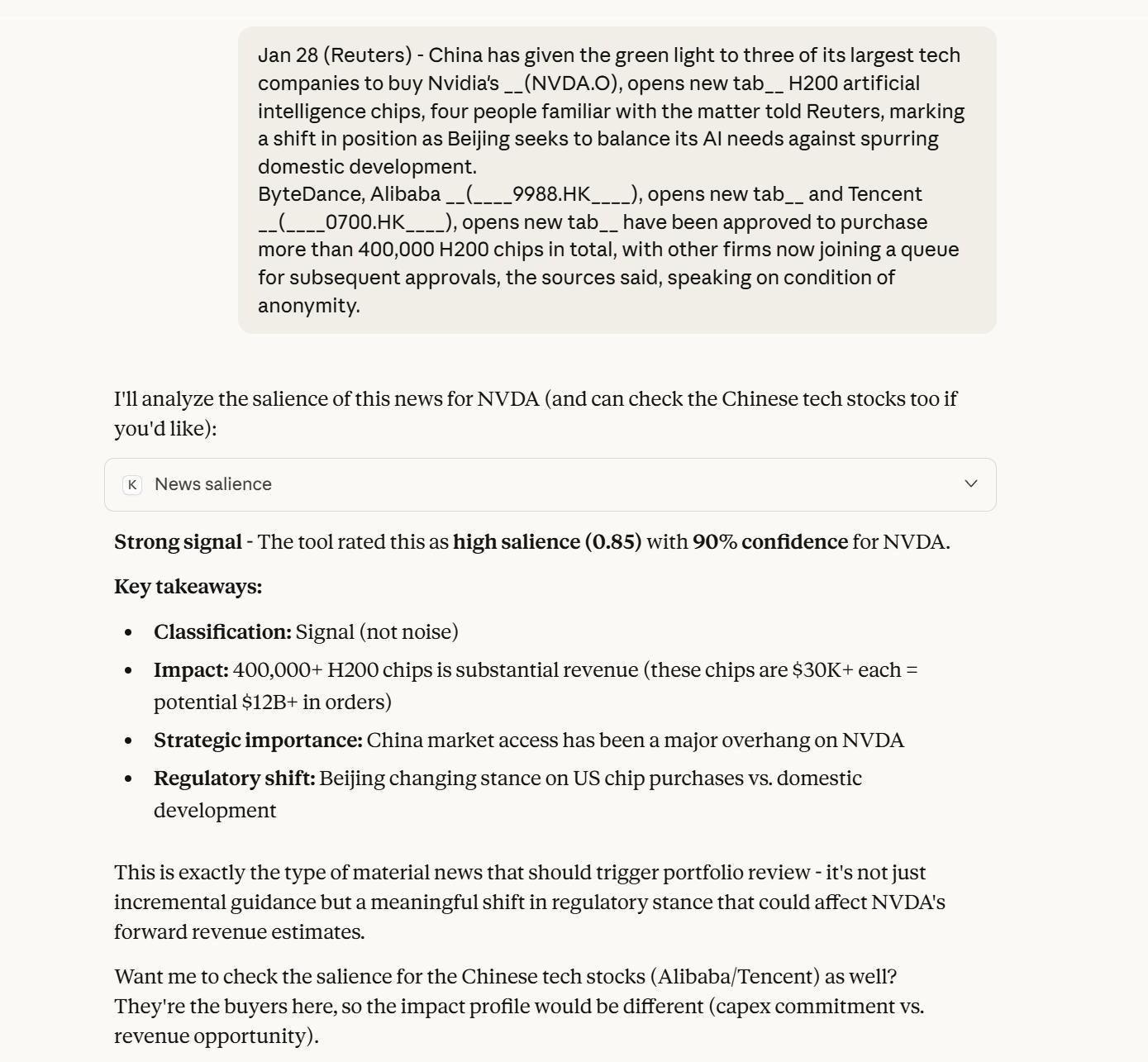
That’s not a summary. That’s a verdict.
And here’s the thing: I didn’t install anything. I didn’t copy an API key. I didn’t read a setup doc or wire together an integration.
I connected the agent. Then I used it.
I’ve spent enough time around agent platforms to know where demos go to die.
It’s not model capability. The models are good enough. It’s everything that happens after someone says “cool, how do I actually use this?”
Where do I get the key? What endpoint do I hit? Is this safe in production? Can I revoke access? Who’s auditing what happened?
That’s not an AI problem. That’s an integration ergonomics problem. A security problem. A “my compliance team will never approve this” problem.
Most agents don’t fail because they’re not useful. They fail because the last mile is too hard.
Here’s what Claude sees when the News Salience agent is connected:
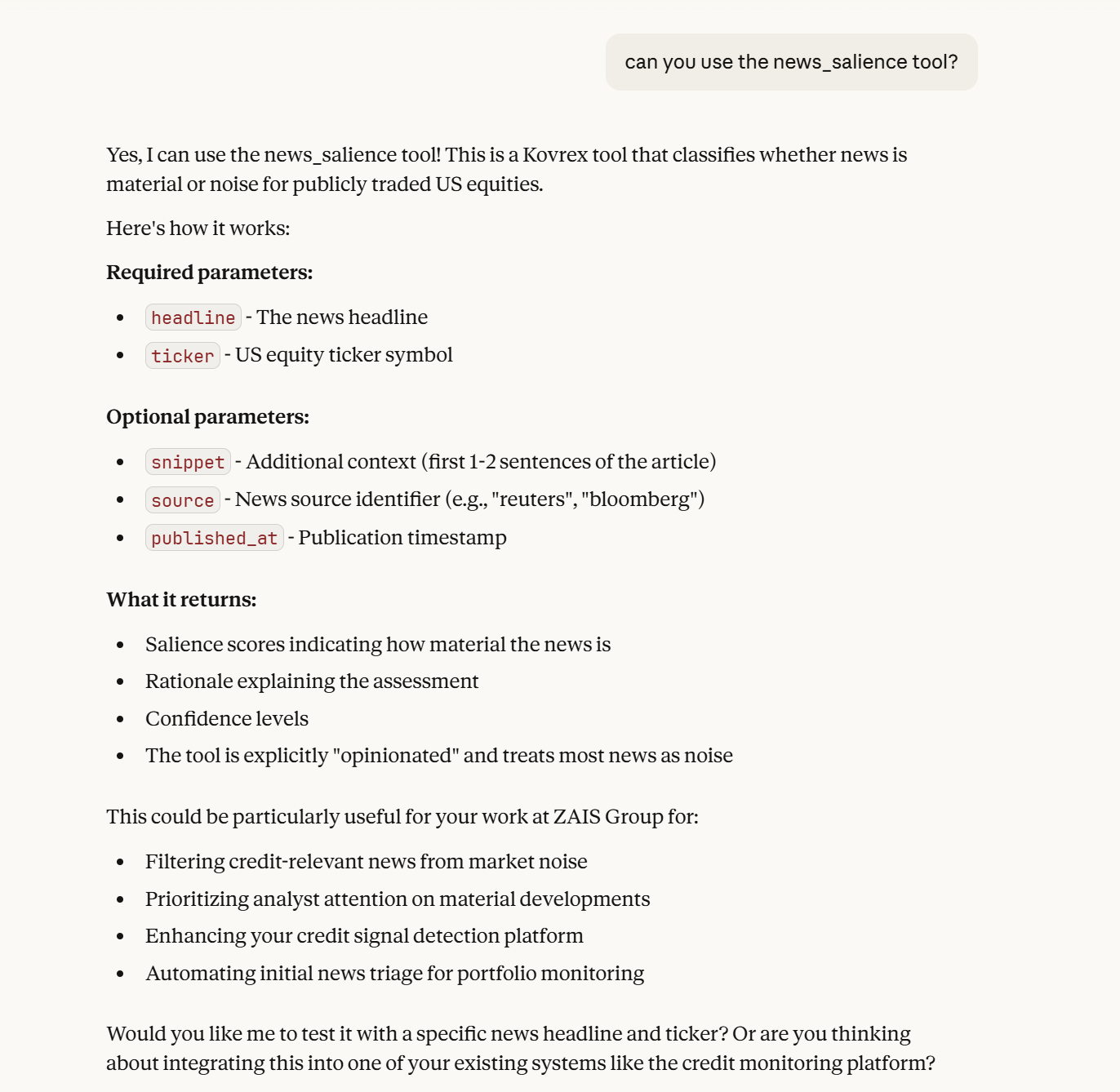
Required parameters: headline, ticker. That’s it.
Optional: snippet, source, published_at if you want more context.
What it returns: salience scores, rationale, confidence levels. The agent is explicitly opinionated. It treats most news as noise. That’s the point.
No SDK. No local server. No “read this doc and figure out the auth flow.”
The agent is a capability, not an integration project.
Under the hood, three ideas make this work.
A standard way to expose tools.
MCP gives models a consistent interface to discover and call tools. Think USB-C for agent capabilities. If you’ve ever integrated tools into LLMs before, wiring up function calling, handling responses, managing state, you know how much friction disappears when the interface is standardized.
The agent publishes what it can do. The model knows how to call it. Done.

A standard way to authorize access.
OAuth is what turns “try this agent” into something a real team can approve.
Scoped permissions. Revocable access. Separation between sandbox and production. A path to audit and controls.
This is the part enterprises actually care about. Not “can it do the thing” but “can we let it do the thing safely, with accountability, in a way that doesn’t make our security team twitch.”
Sandbox and production as a default.
When you connect, you see both endpoints. You’re not guessing how to test safely. Play in sandbox. Graduate to production when you’re ready.
This sounds obvious. It’s not. Most agent demos assume you’ll figure out your own testing strategy. Which means most agent demos never make it past the demo.
The mental model shift is subtle but important.
Old model: “Here’s an API. Good luck.”
New model: “Here’s a capability you can grant, revoke, and observe.”
That’s what makes a marketplace for live agents possible. Not a directory of prompts. Not a GitHub repo you clone and deploy yourself. A place where agents behave like services: connectable, addressable, measurable.
One caveat.
Even when tool calling works perfectly, the machinery is still hidden. Models can still embellish — sound confident, produce plausible narratives around tool results. The agent gave me structured data; the model interpreted it. Those are different things.
That’s why I keep coming back to the same idea:
Trust isn’t a claim. It’s a record.
One-click installation is table stakes. The part I care about most comes next: schema compliance, refusal behavior, provenance, behavioral tracking over time.
Because the goal isn’t a cool demo in chat. The goal is an ecosystem of agents you can actually rely on.
If you want to try this yourself, the News Salience Filter is live on Kovrex. Connect it in Claude Desktop, drop a headline and a ticker, and see what comes back.
And if you’re building agent workflows in regulated environments: this is the bar. Secure connection. Clean ergonomics. Observable behavior.
Because agents don’t need better demos. They need better distribution.